

Ecommerce SEO in 2026: Why 90% of Product Pages Are Invisible
And what the top 10% do differently — a field report from auditing dozens of fashion, apparel, and D2C brands
Do You Know How Many Touchpoints a Customer Goes Through Before Buying Your Product?
Here's a hint: it's not one.
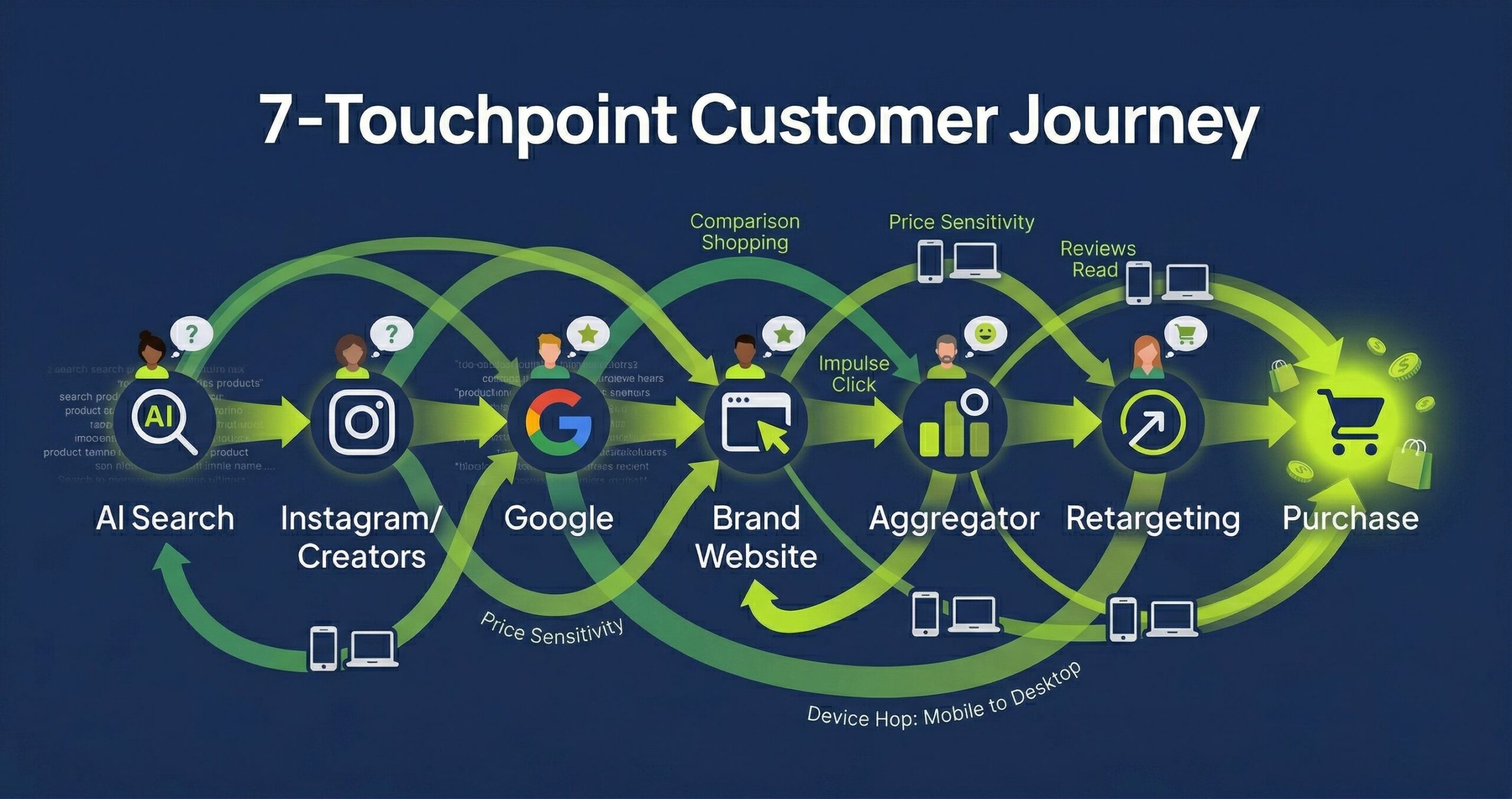
Let's say someone wants to buy a sunscreen. What do they actually do in 2026?
First, they go to an AI tool — ChatGPT, Gemini, Perplexity — and ask something like "best sunscreen for oily skin" or "best sunscreen under ₹500." They get a list of five brands. Now they have options.
Next, they go to Instagram. They search for those brand names, watch creator reviews, look for real-life testimonials. Out of those five brands, maybe two or three have actual creator content — real user videos, dermatologist mentions. The other two? No presence. No posts. No creator collaborations. They're already off the shortlist.
Then they go to Google. They visit the remaining brands' websites — checking ingredients, certifications, whether it's dermatologist-tested. They compare. They narrow it down to two or three.
Then they go to Amazon, Nykaa, or another aggregator. They compare prices. Check for offers. Read customer reviews.
And finally — after all of this — they see a retargeting ad from one of those brands offering a better deal. They click. They buy.
Now here's the question: which touchpoint do you attribute this conversion to? The AI tool that surfaced your brand? The creator who built trust? The Google search? The ad that closed?
The truth is — the decision was made across all of them. Remove any single touchpoint and your brand falls off the shortlist. This is how buying decisions work in 2026. And yet, when we audit ecommerce websites, we find that most brands are optimizing for exactly one touchpoint: their product page on Google.
Everything else — collections, content, images, social presence, AI discoverability, comparison positioning — is either missing or broken.
After auditing dozens of fashion, apparel, and D2C sustainability brands — primarily serving markets outside India — here are the patterns we see again and again. These are the mistakes keeping 90% of product pages invisible, and what the top 10% do differently.
The Audit Reality: 7 Out of 10 Sites Still Get the Basics Wrong
This is the uncomfortable starting point of almost every ecommerce SEO engagement we take on. Before we even get to strategy, content, or multi-touchpoint visibility — the foundation is broken.
Out of every 10 ecommerce websites we audit, 6 to 7 still have basic on-page SEO issues that should have been addressed before the site launched. Title tags auto-generated by the platform. Missing or duplicate meta descriptions across hundreds of product pages. Heading structures that skip from H1 to H4. Image alt text completely absent. Canonical tags missing or misconfigured.
And here's the one that catches even experienced marketers off guard: among ecommerce sites with missing canonical tags, an average of 40.38% of their pages are affected. That means a significant chunk of their product catalogue is competing against itself — duplicate versions of the same page diluting each other's authority.
None of this is advanced SEO. It's the foundation. And if the foundation is cracked, no amount of content marketing, social media, or AI optimization will fix it. The first move is always the same: audit, fix the basics, then build.
Your Products Have Names. Your Customers Have Questions.
This is one of the most persistent blind spots we encounter, particularly with fashion and D2C founders who are deeply invested in their brand identity — as they should be. But brand identity and search discoverability operate in different languages, and most ecommerce sites fail to bridge the gap.
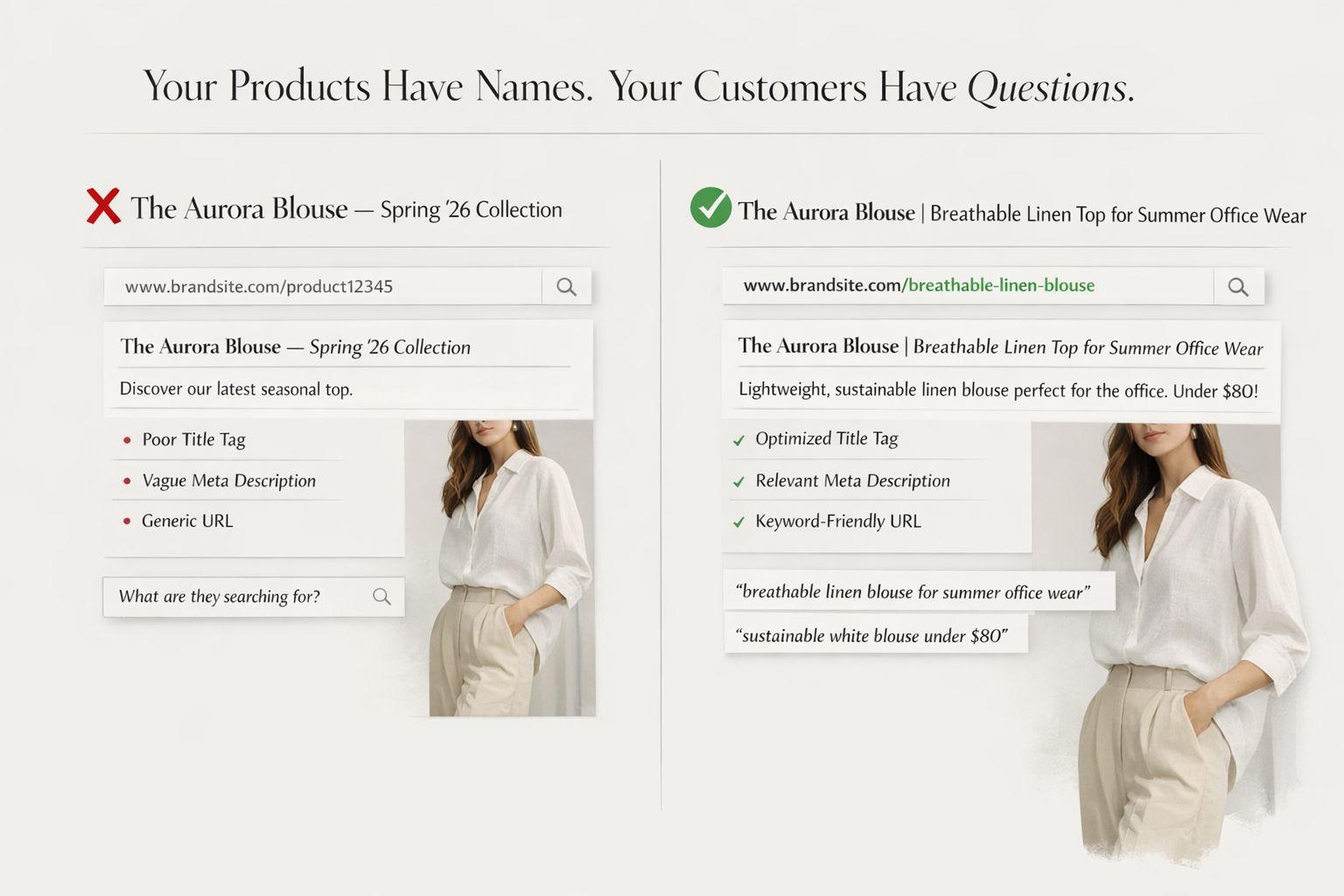
Here's what this looks like in practice. A sustainable fashion brand names a product "The Aurora Blouse — Spring '26 Collection." Beautiful name. Strong brand story. Zero search volume. Meanwhile, their ideal customer is typing "breathable linen blouse for summer office wear" or "sustainable white blouse under $80" into Google, ChatGPT, or Instagram search.
The product exists. The customer is searching. But the product name, page title, H1 tag, and meta description all speak brand language — not customer language.
The fix isn't about killing the brand name — it's about layering. The product name stays. But the page title carries both: "The Aurora Blouse | Breathable Linen Top for Summer Office Wear — [Brand Name]." The H1, meta description, and product description weave in the language your customer actually uses. The URL includes descriptive terms, not internal SKU codes.
This is a balance — emotional brand positioning on one side, search intent on the other. Founders too attached to brand-centric naming without this bridge are leaving their most relevant customers unable to find them.
The Collection Page Is Your Most Underused SEO Weapon
Ask any ecommerce founder how they organize their collections and you'll hear the same answer: by product type. Tops. Bottoms. Dresses. Accessories. Maybe a seasonal collection. That's it.
This is catalogue thinking. Not SEO thinking.
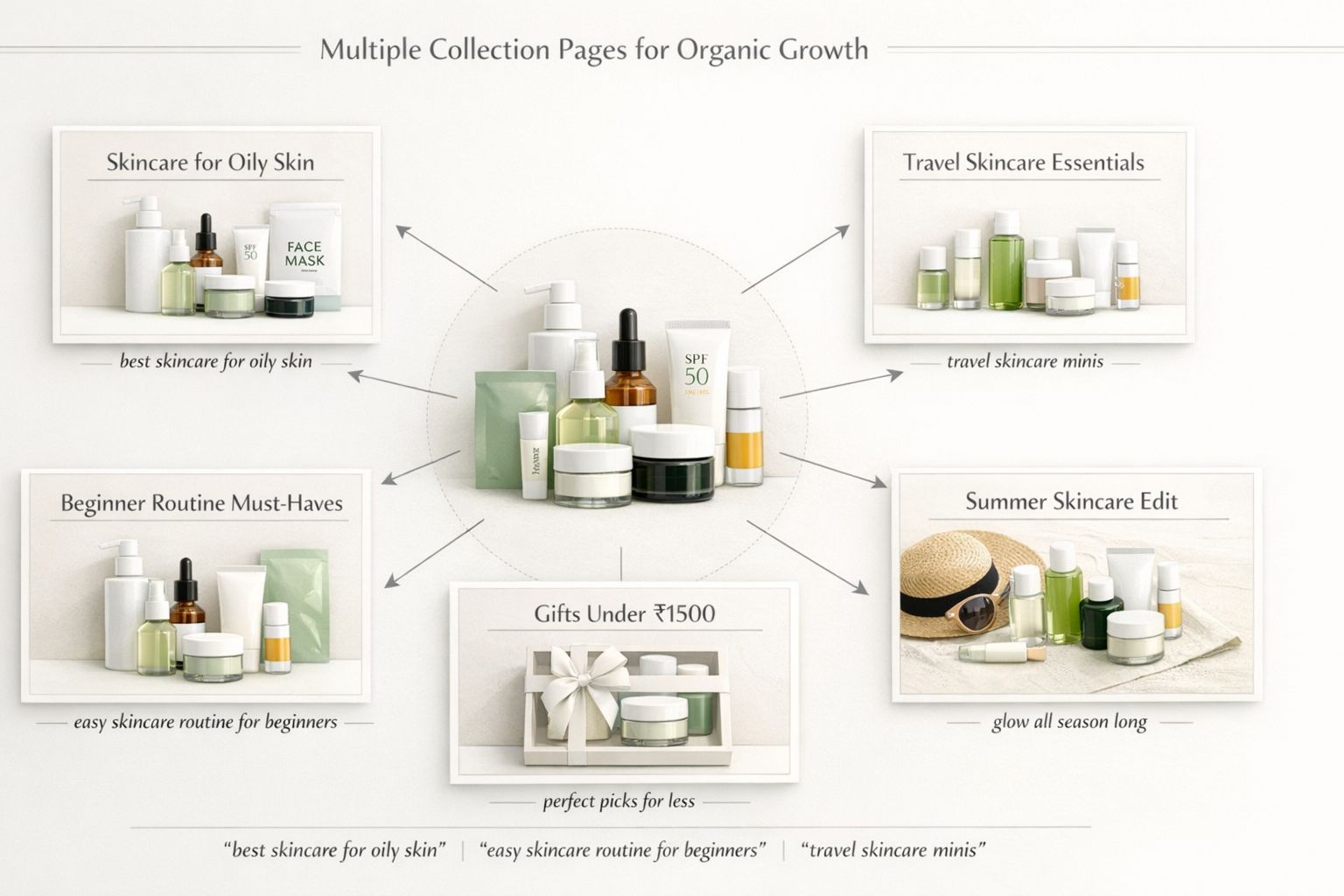
From the same set of products, dozens of high-intent, rankable collections can be created — and most brands are leaving this organic real estate completely untapped.
Think about it from the customer's search intent. A customer doesn't type "tops" into Google. They search "breathable workwear for summer," "sustainable gifts under ₹2000," "capsule wardrobe essentials for minimalists," or "organic cotton basics for sensitive skin." Each of these is a real search query with real volume. And each one can be answered with a collection page — using products you already have.
Every intent-based collection you create is a new organic entry point. A new URL that can rank for a long-tail keyword cluster. A new page that can appear in AI Overviews — where 80% of cited sources don't rank organically for the original query (Stryde). A new asset for your social media team to promote.
Take your existing product catalogue and create collections by problem statement, by occasion, by customer segment, by price bracket, and by use case. You're not creating new products. You're creating new ways for the right customer to find the products you already have. The top brands generate 5-10× more organic entry points from the same inventory.
Product Pages That Do Nothing But Describe the Product
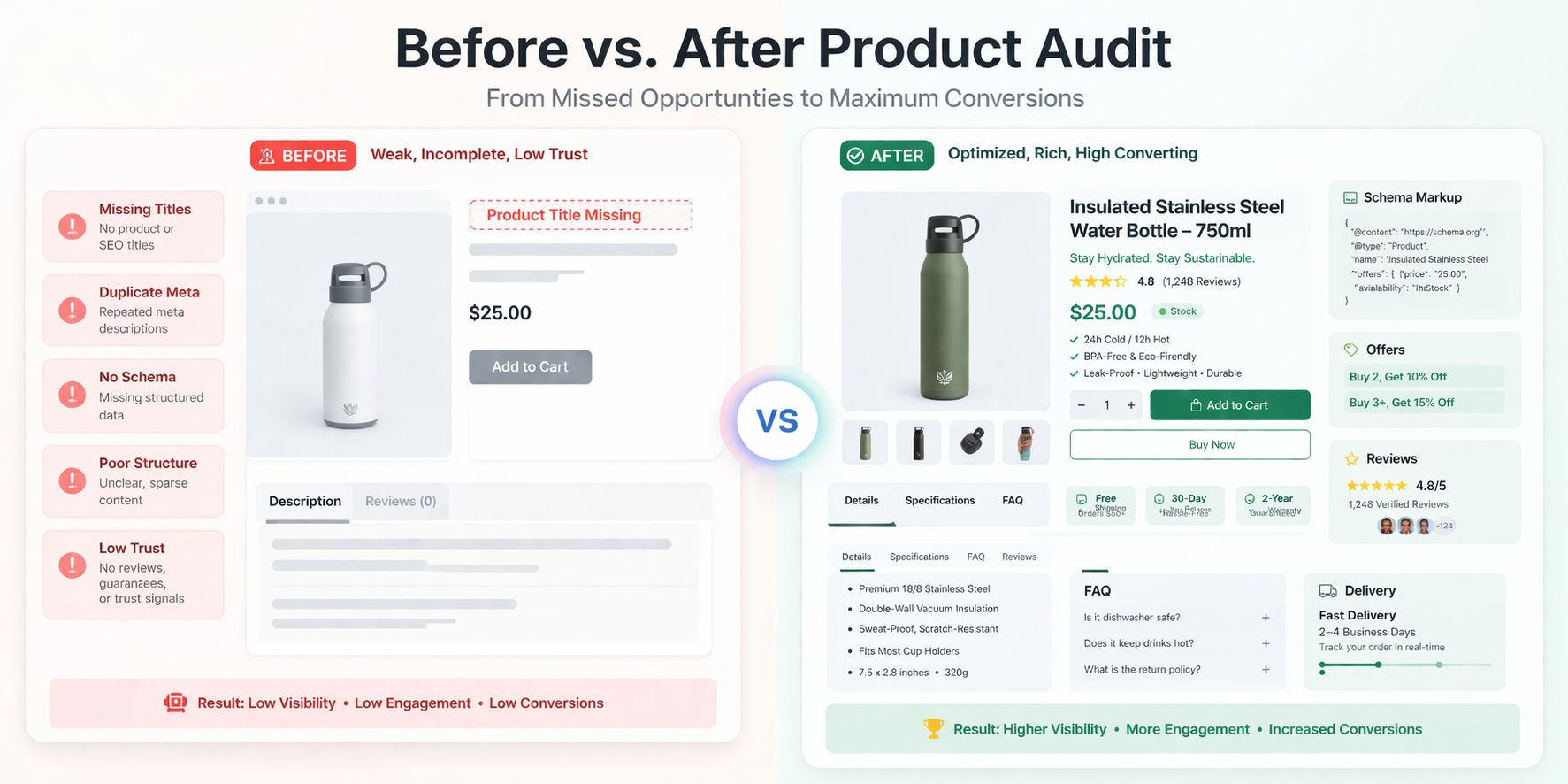
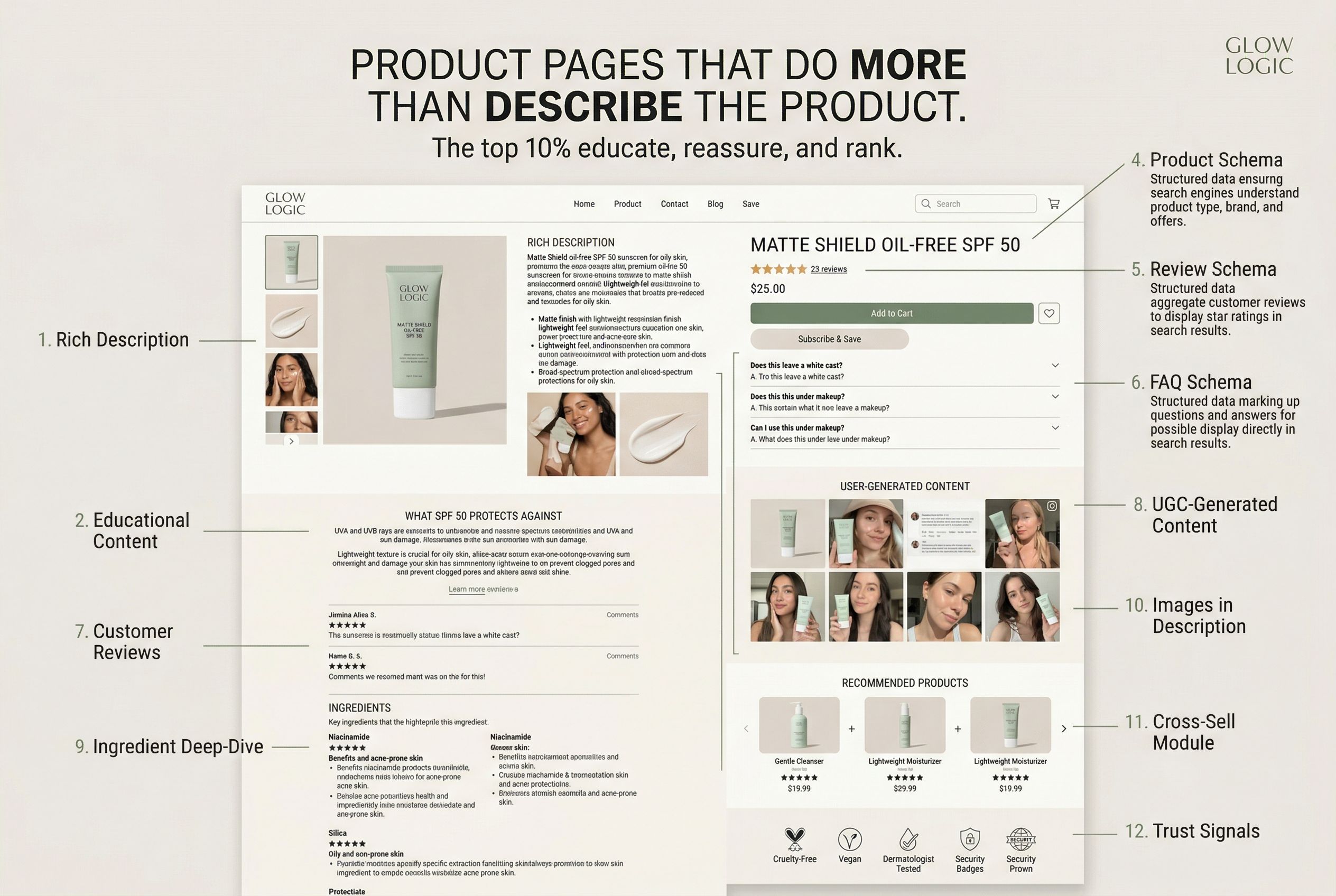
Open any average ecommerce product page and here's what you'll find: a product name, 2-3 lines of description, a price, an "Add to Cart" button, and maybe a few images. That's not a page — it's a catalogue entry. And Google treats it accordingly.
So what does a product page that earns organic visibility actually look like? It looks like a page that answers every question a customer would ask a salesperson in a physical store.
The top 10% include rich product descriptions that go beyond features and into use cases, styling suggestions, and objection handling. They include FAQ sections built from real customer questions. They implement Product schema, Review schema, and FAQ schema so search engines and AI tools can parse the page structure. They incorporate customer photos, reviews, and testimonials.
And they address something most brands forget entirely: the product description should educate, not just describe. If you're selling a sunscreen, don't just list "SPF 50, lightweight formula." Explain what SPF 50 actually protects against, why lightweight matters for oily skin, how the formula compares to chemical vs. mineral alternatives. Give the customer a reason to stay on the page and read.
Your Images Are Your Biggest Untapped SEO Asset
This is the gap most ecommerce brands don't even know exists. When someone mentions "image SEO," the conversation immediately jumps to alt text. But alt text is the last step — not the first. And if that's all you're doing, you're barely scratching the surface.
Image SEO for ecommerce is a five-step discipline — and most brands are only doing step five (and badly at that).
Think About What You Photograph
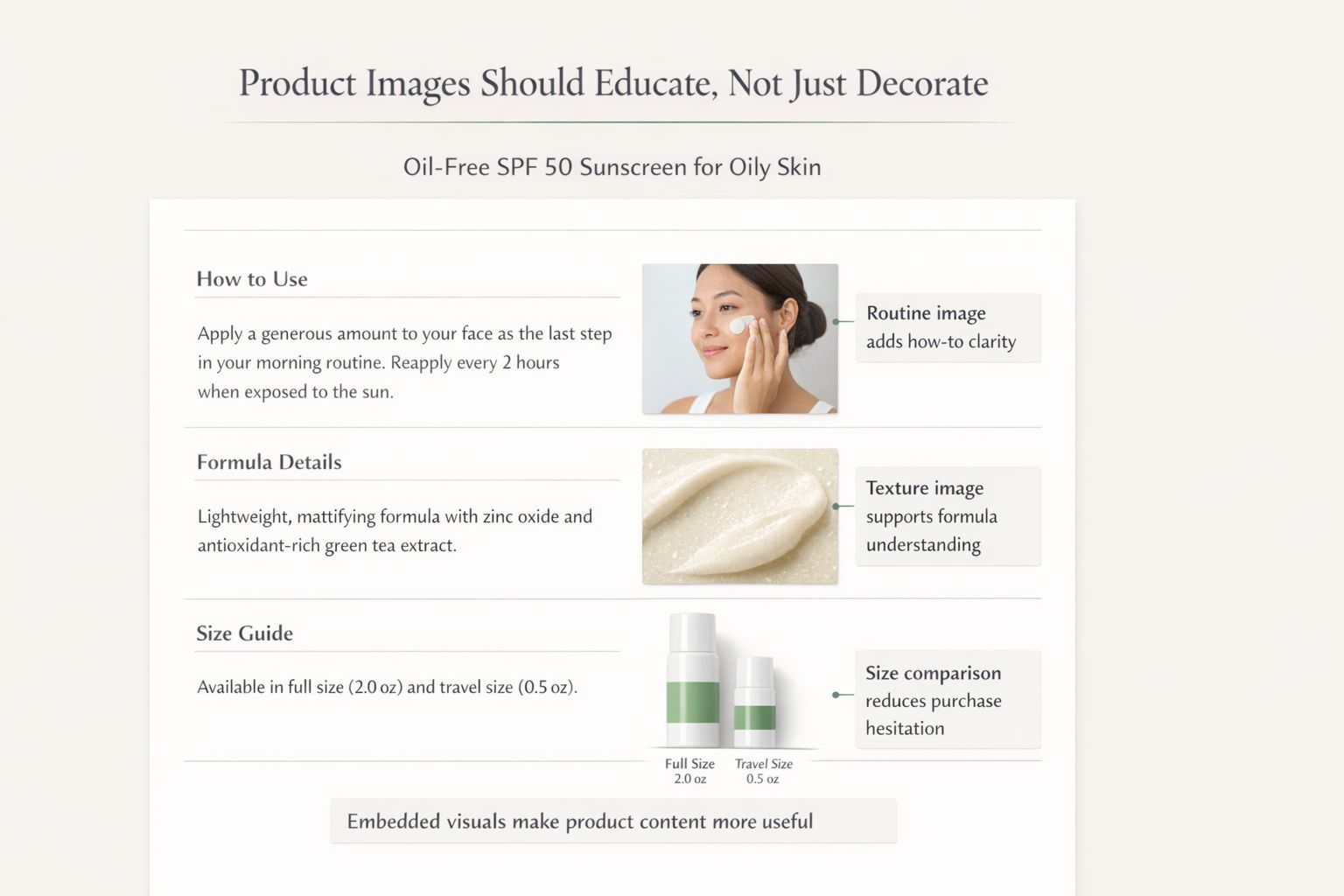
A single product shot on a white background is table stakes. The brands winning in image search are shooting: lifestyle images (product in context — worn, styled, in use), feature-explanation images (close-up of fabric texture, stitching detail, ingredient callout), use-case images (the product in different scenarios — office, outdoor, travel), and comparison images (product next to a hand, coin, or another product for scale). Each image type targets a different search intent.
Fix Your Naming Convention — Before Upload
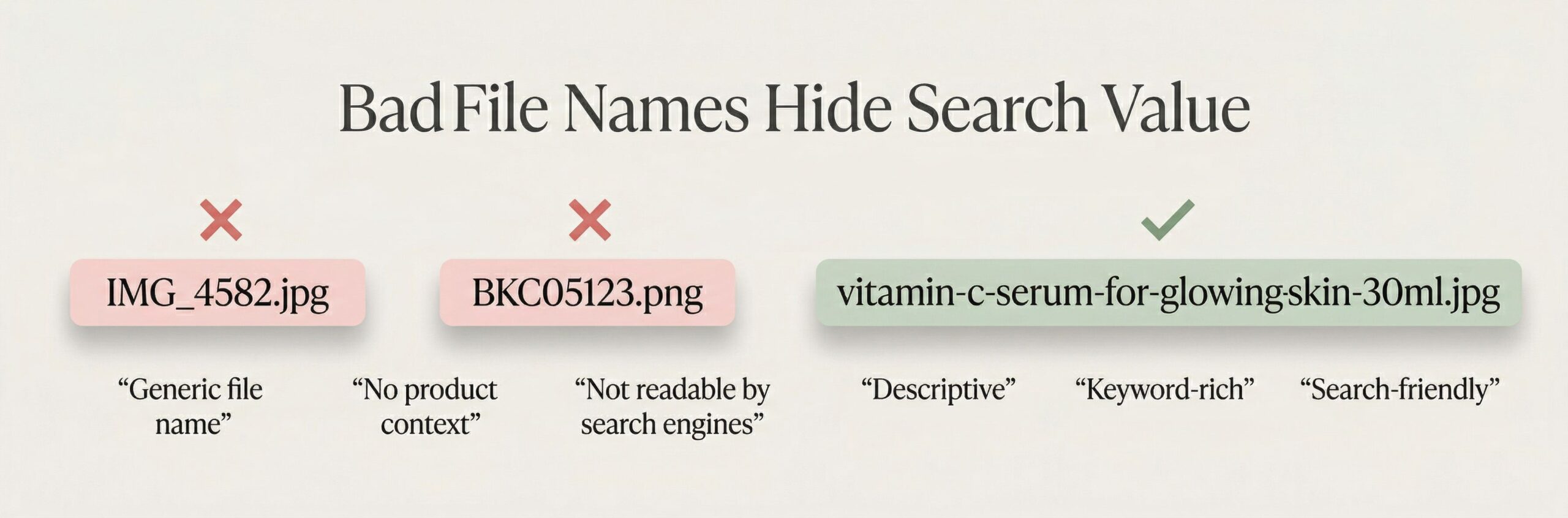
The typical ecommerce product image filename: IMG_4582.jpg or BKC05123.png. These tell Google nothing. The filename should describe what the image shows: organic-cotton-relaxed-fit-tee-sage-green.jpg or breathable-linen-blouse-summer-office-lifestyle.jpg. The image filename is one of the first signals Google uses to understand image content. A descriptive name before upload is worth more than perfect alt text after.
Manage Your Image Library — Don't Just Bulk Upload
Shopify (and other platforms) has a known issue of creating duplicate copies of the same image when products are uploaded in bulk. This creates crawl bloat and dilutes image SEO value. Smart brands audit for duplicates, use one source image and tag it intentionally across multiple relevant pages — a lifestyle image of a linen shirt can appear on the product page, the "summer collection" page, and a style guide blog post.
Write Alt Text That Actually Describes
Alt text isn't a keyword stuffing field. It's a description for someone who can't see the image. "Woman wearing sage green organic cotton tee in an outdoor café setting" is useful. "Green tee organic cotton buy now best price" is spam. Each image instance should have contextually appropriate alt text — the same image on a product page and a style guide should have different descriptions matching the surrounding content.
Use Images as Content Within Descriptions
Don't stack all images in a gallery at the top and write text below. Weave images into the product narrative. Place a feature callout image next to the paragraph explaining fabric technology. Put a lifestyle image alongside the "how to style it" section. Insert a size comparison within the fit guide. Image-text integration signals a more comprehensive, useful page to search engines.
Cross-Selling and CRO Aren't Separate From SEO
Most ecommerce brands treat cross-selling as a UX feature and conversion rate optimization as something the growth team handles. Neither gets connected to SEO strategy. This is a mistake.
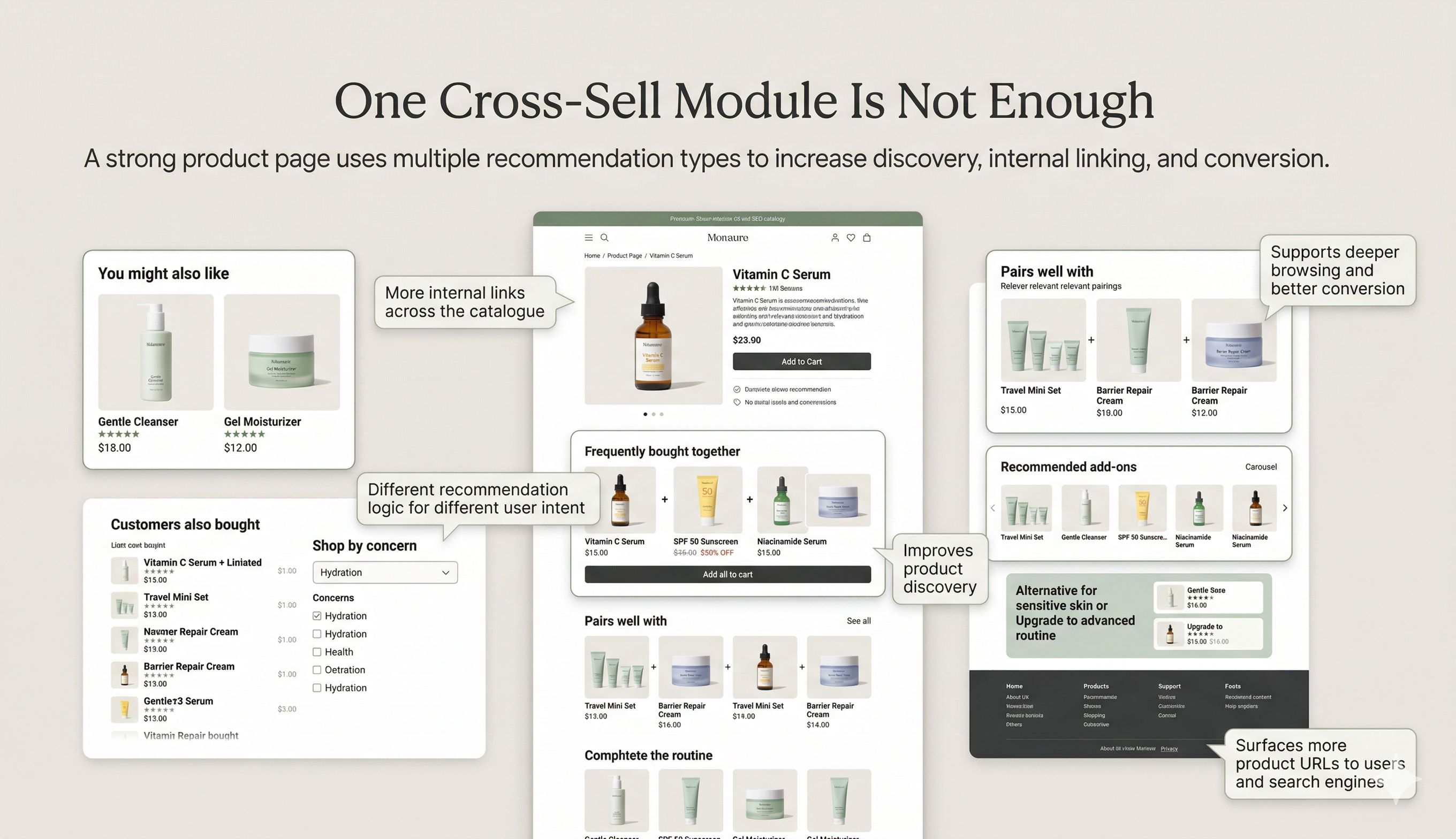
Every "You might also like" or "Complete the look" module on a product page is an internal link. Internal links are how search engines discover, crawl, and distribute authority across your website. When your cross-sell modules are thoughtfully implemented, they create linking pathways that connect products across categories, surface deeper catalogue pages that would otherwise be orphaned, and distribute page authority across a wider set of URLs.
The conversion impact reinforces the SEO impact. When a customer engages with a cross-sell recommendation, they visit more pages, spend more time on site, and generate the engagement signals that search engines interpret as quality indicators. Lower bounce rates, longer sessions, and higher pages-per-visit all feed into how Google evaluates whether a page deserves to rank.
SEO doesn't end when the user lands on the page. What happens next — whether they engage, explore, and convert — feeds directly back into your organic performance. Cross-selling and CRO aren't separate strategies. They're the second half of your SEO strategy.
You're Only Building Three Types of Pages. You Need Ten.
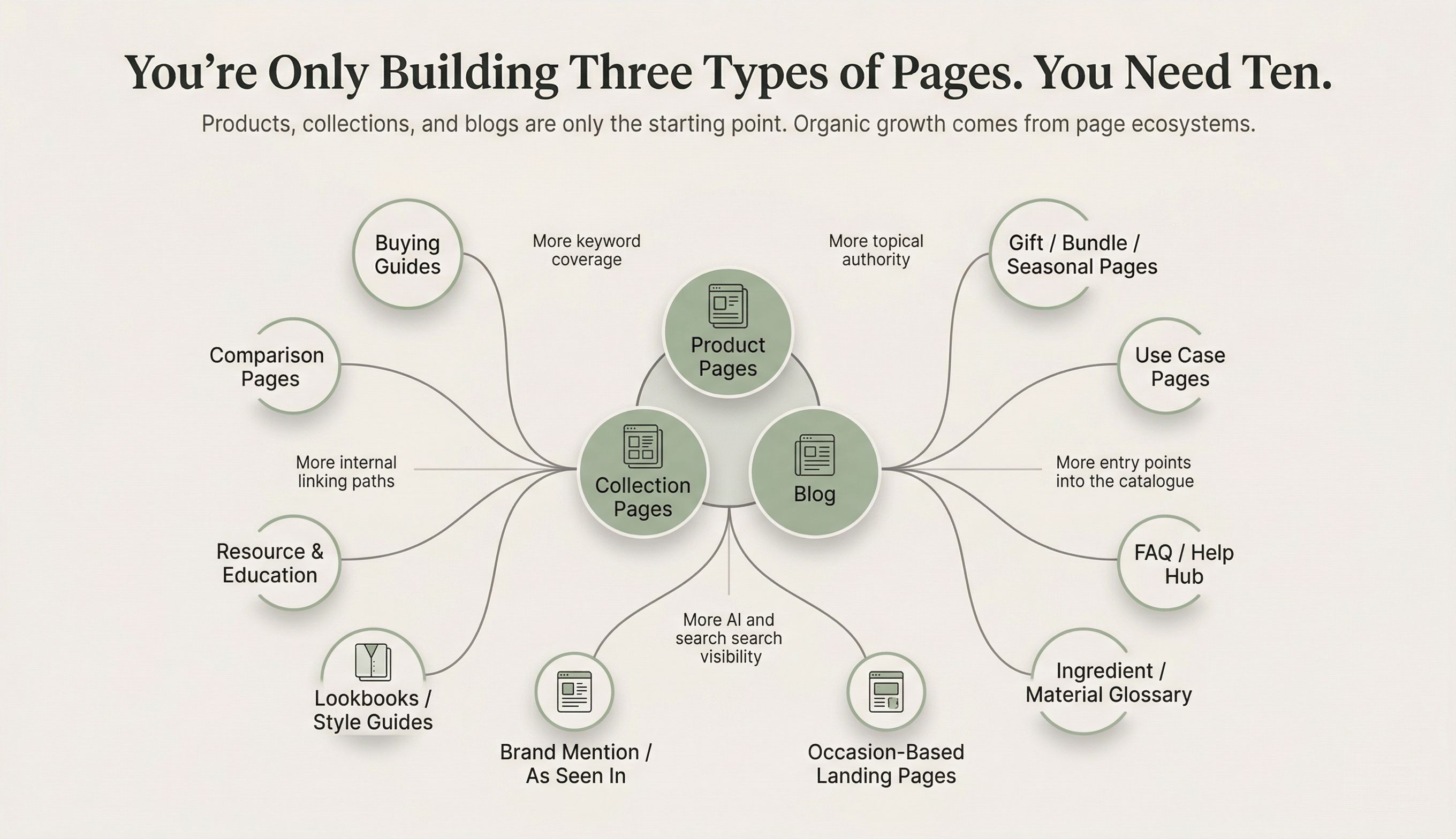
This is the mental model trap that limits almost every ecommerce site we audit. Products, collections, and a blog. That's three page types covering maybe 30% of the organic opportunities available. The remaining 70%? Untouched.
Buying Guides
"How to choose the right running shoe for your foot type." These target top-of-funnel research queries that AI tools and Google's featured snippets love to surface. They position your brand as the expert before the customer reaches a product page.
Comparison Pages
Brand vs. brand. Product vs. product. "Organic cotton vs. bamboo fabric: which is more sustainable?" These capture high-intent, bottom-of-funnel queries. 83% of online buyers use Google to check reviews before purchasing (BrightLocal) — comparison content meets them at that exact moment.
Resource & Education Sections
Ingredient glossaries. Fabric care guides. Sustainability reports. Sizing methodology explainers. These build the topical authority that makes AI tools and search engines recognize your brand as a genuine expert in your category.
Lookbooks & Style Guides
Visual content that ranks in Google Image search, attracts social shares, and creates internal linking opportunities back to product and collection pages.
Occasion-Based Landing Pages
"What to pack for a tropical vacation." "Office-appropriate summer wardrobe." Search queries with clear purchase intent that no product page or standard collection can capture.
Brand Mention & "As Seen In" Pages
If your product has been featured in press, mentioned by creators, or reviewed by publications — build pages around that. These capture non-branded search traffic most brands don't even know exists, and they feed the authority signals that AI tools prioritize.
The brands winning organic visibility are building interconnected content ecosystems around their products — not just listing products and hoping for the best. Content strategies are shifting from keyword-focused pages to topic ecosystems and entity coverage.
The Customer Journey Has 7 Touchpoints. Your SEO Covers 1.
Let's come back to where we started — because this is the insight that ties everything together.
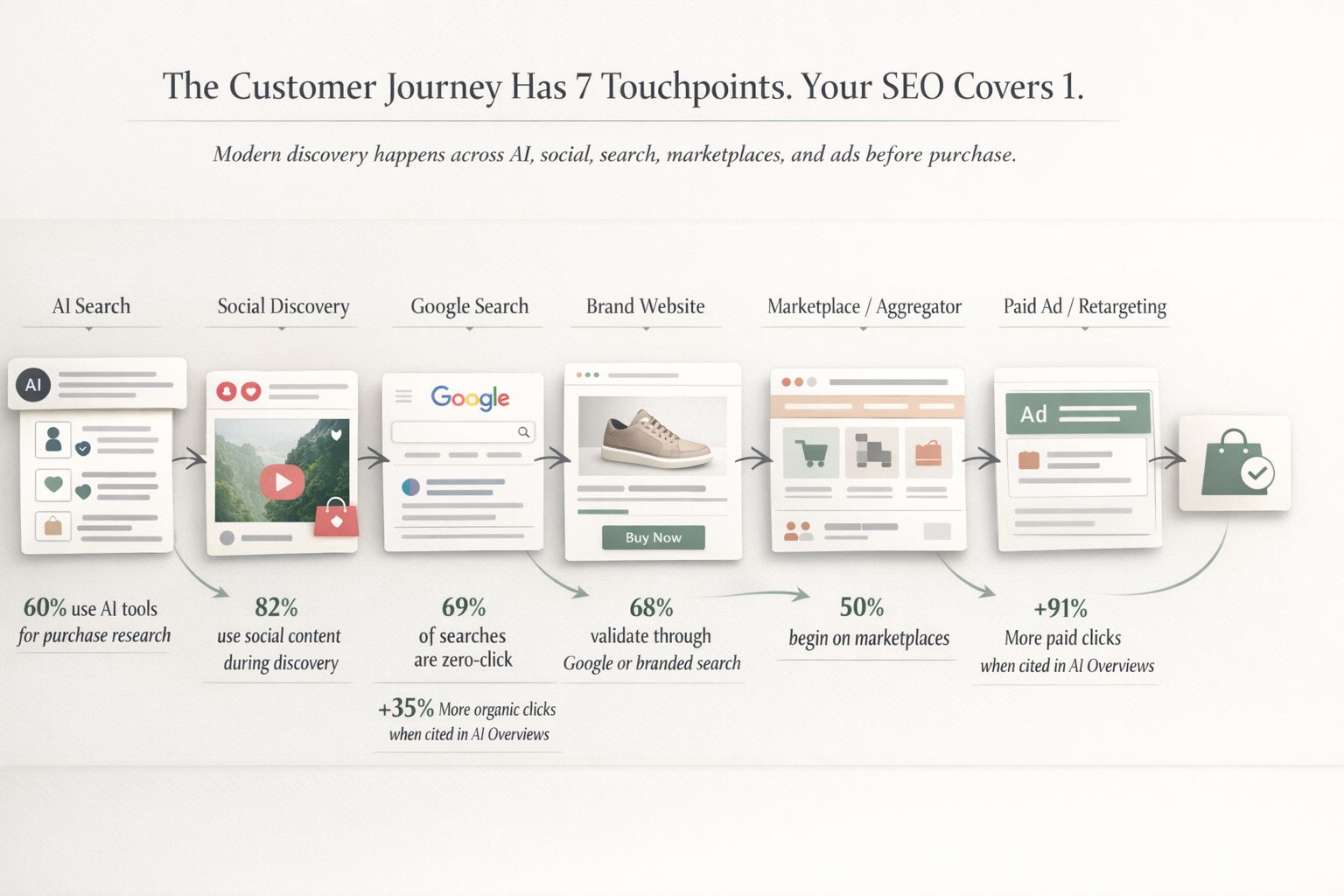
The modern ecommerce customer journey is not a straight line from Google to your product page to checkout. It's a multi-platform, multi-touchpoint discovery process that spans AI search, social media, your website, aggregator platforms, and paid advertising — all before a single purchase is made.
So what does this mean for your ecommerce SEO strategy? It means your optimization can't stop at your website.
AI discoverability: Is your brand structured in a way that AI tools can reference it? Do you have clear, authoritative content about your product category that LLMs can draw from?
Social search presence: When someone searches your brand or product category on Instagram, YouTube, or TikTok — do they find content? Creator reviews? Or silence?
Aggregator positioning: Are your products properly listed and competitively priced on marketplaces where customers compare?
Branded search authority: When someone types your brand name into Google after discovering you on social or AI, does your ecosystem present a cohesive, trustworthy picture?
Only 1-2% of ecommerce brands are actually mapping this full journey and using it to inform their content and page strategy. That's the gap — and it's the single biggest opportunity in ecommerce SEO today. This is what we mean when we talk about Search Everywhere Optimization.
What the Top 10% Do Differently
After working across fashion, apparel, D2C sustainability brands, and ecommerce businesses at various stages of growth — here's the framework that separates the brands winning organic visibility from the 90% that stay invisible:
Fix the foundation first. Basic on-page SEO, canonical tags, internal linking, site speed — before anything else. No strategy survives a broken technical base.
Name products for customers, not just for themselves. Brand identity and search intent coexist. The page title, meta description, and H1 carry both.
Build collections around intent, not just categories. The same products create 5-10× more organic entry points when organized by problem, occasion, segment, and use case.
Treat product pages as content, not catalogue entries. Rich descriptions, FAQs, structured data, UGC, and educational depth.
Treat images as a complete SEO discipline. Thoughtful photography, descriptive naming, duplicate management, contextual alt text, and image-text integration.
Connect cross-selling and CRO to organic performance. Internal linking through recommendation modules, engagement optimization, and page experience improvements.
Build ten types of pages, not three. Buying guides, comparison pages, resource sections, lookbooks, occasion landing pages, and brand mention content — all interconnected.
Optimize for every touchpoint, not just Google. AI discoverability, social search presence, aggregator positioning, branded search authority, and retargeting alignment.
Frequently Asked Questions
Q] How many touchpoints does a customer go through before buying online?
A] Modern ecommerce purchase decisions typically involve five to seven or more touchpoints across AI search tools, social media platforms, search engines, brand websites, aggregator marketplaces, and paid advertising. Customers narrow their options at each stage, and brands absent from any key touchpoint risk being eliminated before the purchase decision is made.
Q] Do product pages need unique content for SEO?
A] Yes. Product pages with only a name, price, and 2-3 line description are treated as thin content by search engines. Top-performing ecommerce sites include rich descriptions, FAQ sections, structured data (Product, Review, FAQ schema), and user-generated content. Pages with schema markup achieve 20-40% higher click-through rates.
Q] What is a collection page in ecommerce SEO?
A] A collection page groups products around a shared theme. The biggest SEO opportunity lies in creating intent-based collections organized by problem statement, occasion, customer segment, price bracket, or use case — not just product type. Each collection becomes a new organic entry point.
Q] How should I name product images for SEO?
A] Name images with clear, descriptive language before uploading — never default camera filenames or SKU codes. A good filename like "organic-cotton-relaxed-fit-tee-sage-green.jpg" helps search engines understand the image content before even looking at alt text.
Q] Does cross-selling help SEO?
A] Yes. Cross-sell modules create internal links that distribute authority across your product catalogue and improve engagement metrics — more pages per visit, lower bounce rates, longer sessions — all of which are quality signals that influence rankings.
Q] Can ecommerce brands appear in AI search answers?
A] Yes, but only 0.3% of AI Overviews currently include ecommerce sources directly. Brands with authoritative category content — buying guides, comparisons, educational resources — have a much higher chance of being cited. Being cited earns 35% more organic clicks and 91% more paid clicks.
Q] What pages should an ecommerce site have beyond products and blogs?
A] The top performers build at least ten page types: product pages, intent-based collections, blog posts, buying guides, comparison pages, resource sections, lookbooks, occasion-based landing pages, ingredient deep-dives, and brand mention pages. Each captures a different search intent.
Sources & References
-
[1]
Ahrefs — Search Traffic Study: 96.55% of pages get zero traffic from Google — ahrefs.com
-
[2]
Reboot Online — Ecommerce SEO Statistics: Organic traffic, thin content, internal linking, and UGC data — rebootonline.com
-
[3]
Seer Interactive — AI Overview CTR Study: +35% organic clicks and +91% paid clicks when cited — seerinteractive.com
-
[4]
Baymard Institute — Cart Abandonment Rate Statistics: ~70% average; $260B in recoverable orders — baymard.com
-
[5]
Shopify — Future of Commerce Report: 60% of US shoppers use AI tools for purchases — shopify.com
-
[6]
Google — Product Structured Data Documentation — developers.google.com
-
[7]
Google — Creating Helpful, Reliable, People-First Content — developers.google.com
-
[8]
HTTP Archive — Page Weight Report: Images account for ~38% of webpage weight on mobile — httparchive.org
-
[9]
BrightLocal — Consumer Review Survey: 83% of online buyers use Google to check reviews — brightlocal.com
Your Product Pages Don't Have to Stay Invisible.
Most ecommerce brands reading this will recognize their own site in at least four or five of these patterns. That's not a failure — it's an opportunity. Because your competitors are making the same mistakes.
Share your website with us, and we'll run a complete audit — showing you exactly which of these areas you're missing, where the biggest organic growth opportunities are, and what to fix first.
No generic templates. No recycled playbooks. Just a clear, honest assessment of your organic presence — across your website, your content, your images, your social, and your AI discoverability.
Send Your Website for a Free Audit →Isha is an organic growth strategist with over two decades of experience in search, content, and digital discovery. As the founder of Fixate, she helps brands grow through thoughtful, insight-led organic marketing strategies built for today's evolving search landscape.